

Delta SUBEB Partners UBEC, FME and NEMIS to Strengthen Data Management in Basic Education
December 2, 2025
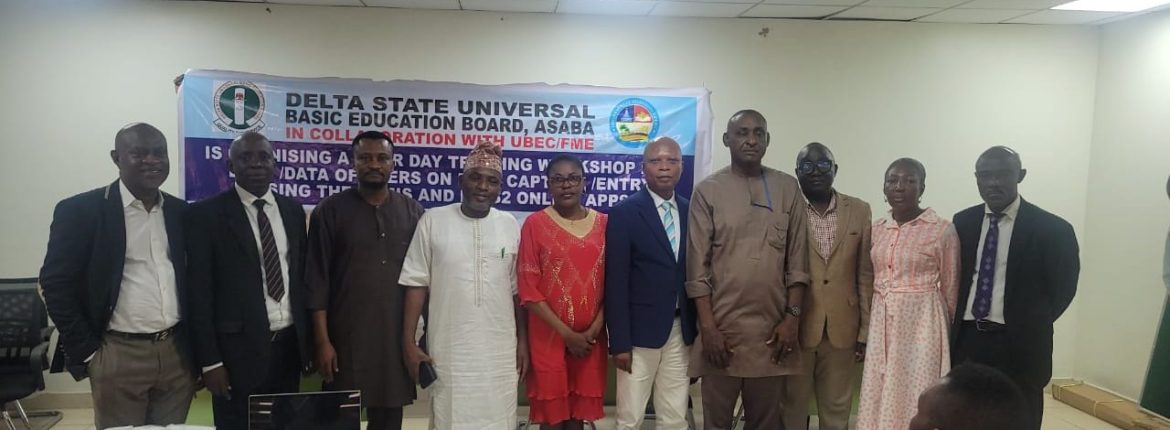
Delta State Universal Basic Education Board (SUBEB), in collaboration with the Universal Basic Education Commission (UBEC) and the Federal Ministry of Education through the Nigeria Education Management Information System (NEMIS), has commenced a four-day intensive training and workshop on Education Management Information for Data Officers in Asaba.
The capacity-building programme which kicked off on Monday, December 1, 2025 is aimed at strengthening officers’ skills in accurate data capture, validation, and entry of primary school pupils and junior secondary school students especially in the public schools, using the Basic Education Management Information System (BEMIS) and District Health Information System 2 (DHIS2) platforms. The training is part of ongoing efforts to improve data quality, planning, monitoring, and evidence-based analysis in the basic education sector.
Speaking during the occasion, the Executive Chairman, Delta SUBEB, Hon. Samuel Mariere, duly represented by the Permanent Secretary, Mr. Byron Unini, highlighted to the participants the importance of accurate and timely education data management in improving planning, monitoring, and service delivery in the basic education sector.
He further emphasized that the training is crucial for Data Officers in SUBEB, the LGEAs, and the Delta State Ministry of Education. He added that these trained officers will, in turn, disseminate the knowledge to teachers at the local government level, ensuring a wider reach and effective implementation of data management practices.
He urged all participants to take the training seriously, highlighting the importance of their role in ensuring accurate and timely education data for effective planning and decision-making.
Also speaking at the event, Director Planning Research and Statistics SUBEB, Mr Charles Eduiyovwiri reinstated the importance of reliable and up-to-date data in driving effective education planning, resource allocation, and policy implementation. Participants were encouraged to take full advantage of the training to enhance their technical competence and professional efficiency.
In an earlier remark, Mr. Ndubuisi Ofuani, one of the organisers from the Federal Ministry of Education and NEMIS, noted that most states across the federation have already adopted this modern method of data collection and management. He emphasized that it is imperative for Delta State to key into the system to align with national standards and best practices.
Mr. Akila Kayit, a Chief Statistician at UBEC, stated that DHIS2 and BEMIS serve as vital tools for standardizing education data collection, ensuring accuracy, and enabling effective planning and policy formulation at both state and federal levels.
He said BEMIS play a critical role in strengthening the education data ecosystem by providing a centralized platform for capturing school-level information, including enrolment, infrastructure, teachers, and learning resources. The integration of DHIS2 further supports real-time data reporting, analysis, and tracking of key indicators.
Other dignitaries present at the capacity-building workshop include Mr. Jubril Abubakar, Chief Statistician, UBEC; Mr. Akan Clement, Federal Ministry of Education and NEMIS; Mrs. Sharon Dafiluelo, UBEC State Coordinator; as well as other Directors from the Delta State Universal Basic Education Board.
Highlights of the training includes practical sessions on data entry procedures, validation rules, system navigation, troubleshooting, and data security protocols. Tablets were provided to participants during the training to facilitate real-time data entry and enhance their efficiency during and after the training.
At the end of the training, participants are expected to demonstrate improved proficiency in handling education data, and also act as mentors and trainers to teachers in their various LGEAs thereby supporting the present administration’s commitment to transparency, accountability, and continuous improvement in the delivery of quality basic education.